Plasma Press
VACUUM-DRIVEN MATERIAL TRANSFORMATION
PLASMA PRESS
Plasma Press writes substrate. Femtosecond pulses inside a vacuum chamber rearrange the material itself — ink is gone, the substrate is the message. The flagship product, the One-Second Book, is a thirty-two-page bound volume produced from a single polymer-V blank in less than a second of in-chamber time. The discipline of Plasma Press is publishing as direct material transformation.
Conventional publishing applies ink to paper. Plasma Press eliminates the ink as a stage. A coherent femtosecond pulse in vacuum ablates micrometre-scale features into a polymer substrate — the text is the geometry of the surface, not a deposit on top of it. There is no drying time. No registration drift. No bleed. No ink supply chain. The substrate carries the publication for the life of the substrate.
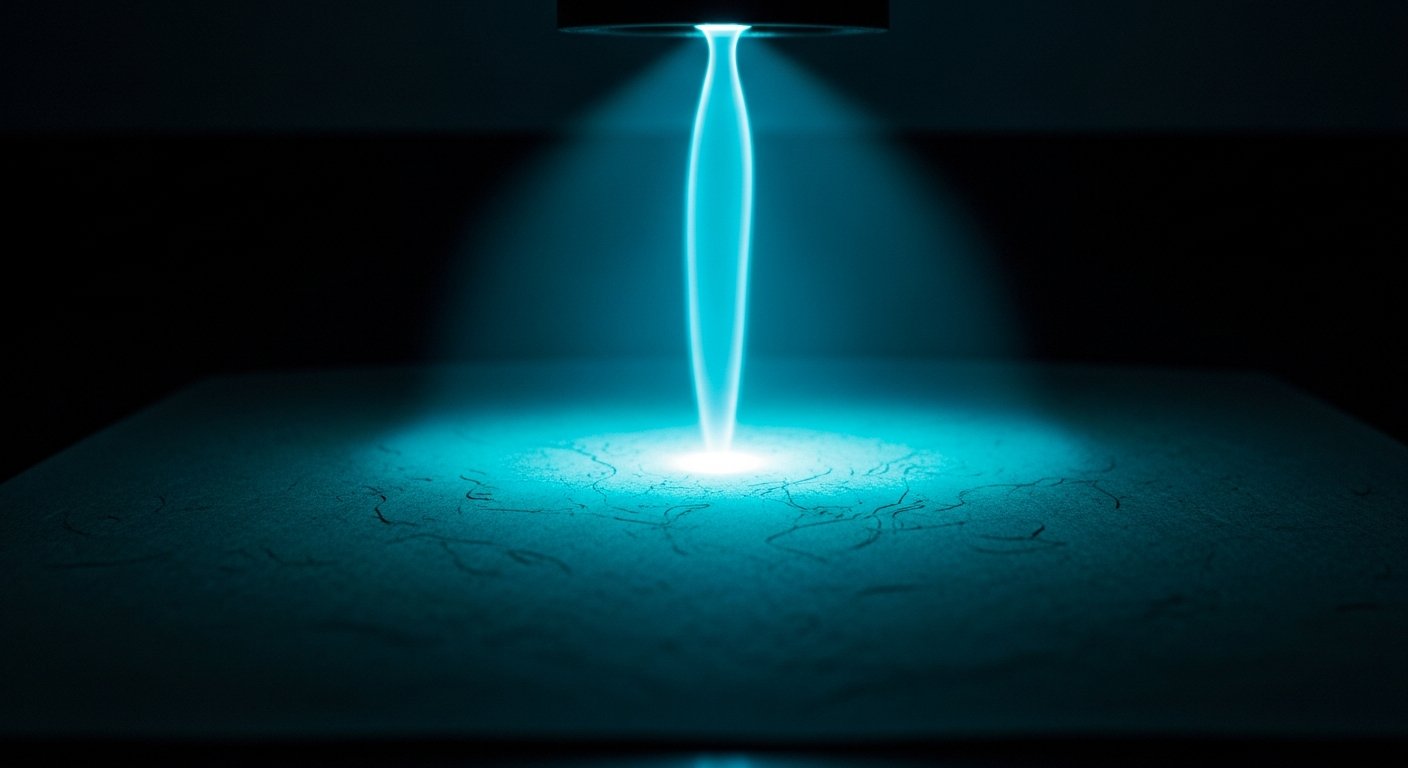
Conventional publishing is slow because ink is slow. We removed the ink. The substrate writes itself.
01 — The Discipline
BOOK EJECTION
Femtosecond-pulse laser ablation removes material with sub-micrometre precision and effectively zero heat-affected zone. The pulse duration is shorter than the timescale over which energy diffuses out of the absorption volume, so the target material is converted directly from solid to plasma in a coherent event — no melt, no recast, no thermal shock to the surrounding substrate. The ablated material is ejected as plasma into the chamber, where it is captured by a vapor-deposition cold trap.1
The substrate is a custom polymer (Polymer-V) engineered to ablate with high contrast: opaque regions absorb the pulse and ablate cleanly; clear regions transmit and remain undisturbed. The polymer is doped with a chromophore tuned to the laser wavelength (typically 248 nm or 193 nm) to give a sharp absorption edge at the pulse energy and a controlled ablation depth per pulse. Multiple passes at varying focal depths produce stacked layers within a single substrate.2
The discipline of Plasma Press is the engineering of this process at industrial throughput. Vacuum chamber for clean ablation. Femtosecond-pulse train for the actual ablation. Polymer-V substrate for repeatable contrast. Sub-millisecond galvanometer scanning to write a full page in milliseconds. Cold trap to capture the ablated plasma. Cassette feeder to load and unload substrates between batches. The throughput is set by the scanner, not by the laser.
02 — The Bottleneck

CODEX BENCHMARK
Conventional offset printing is rate-limited by ink. Each sheet takes ink, transfers it to the paper, and must dry before stacking. Modern web presses run at thousands of pages per minute, but the limit is set by the rotational speed of the ink-transfer drums and by the wet-to-dry transition of the deposited ink. Capital cost scales with throughput; setup time scales with the number of plates to produce; the entire workflow assumes ink as the carrier of information.3
Digital printing — inkjet and laser xerographic — eliminates the plate-making setup but inherits the ink-deposition rate limit. Each pixel must be addressed by a deposit, and the deposit must be cured before the next sheet stacks. The throughput per machine is on the order of two hundred pages per minute for high-end production digital, and the consumable cost (ink or toner) dominates the operating economics.4
The shared bottleneck is the wet-to-dry transition. Both processes deposit a liquid carrier (ink) on the substrate and then wait for it to dry. The drying time sets the minimum spacing between sheets. The fluid handling sets the minimum complexity of the machine. Plasma Press eliminates the wet stage entirely: ablation is dry. No drying. No fluid handling. The substrate is finished the moment the pulse train ends.
03 — The Machine: The One-Second Book
CODEX MACHINE
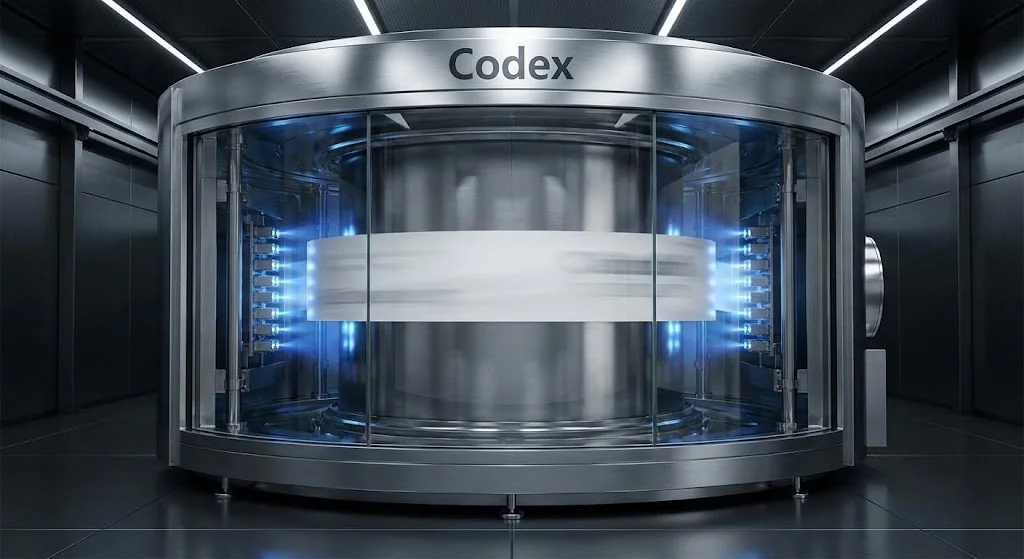
The One-Second Book is the flagship product. A bound thirty-two-page volume produced from a single Polymer-V blank in approximately one second of in-chamber time. Five named sub-systems make the machine:5
The chamber maintains a working pressure of ten-to-the-negative-six torr, evacuated within thirty seconds of loading the substrate cassette. The polymer-V blank is moved by an electrostatic chuck on a magnetic-bearing stage; the stage positions the blank under the femtosecond pulse train within tens of micrometres. No mechanical contact, no contamination, no debris.
An excimer femtosecond laser delivers two hundred picojoule pulses at one hundred megahertz, each pulse around two hundred femtoseconds long. The pulse train is split across thirty-two parallel galvanometer channels, one per page; each channel writes its assigned page in parallel. Total ablation time is approximately two hundred ten milliseconds for a full thirty-two-page book at production-grade text density.6
Each galvanometer channel addresses a one-square-centimetre field through a custom f-theta scan lens. The lens corrects the focal-plane curvature so that every point in the field is in tight focus; the spot size at the substrate is around half a micrometre, sufficient to produce six-point text resolution. The galvanometer is a closed-loop magnetic-bearing optical scanner with positioning error below ten micrometres at full scan speed.
The ablated polymer plasma is captured on a chilled stainless surface inside the chamber. The trap collects roughly one milligram of vaporised polymer per book; the collected mass is consolidated and ejected as a solid pellet during cassette change. The cold trap maintains chamber cleanliness without continuous pumping during the ablation cycle.
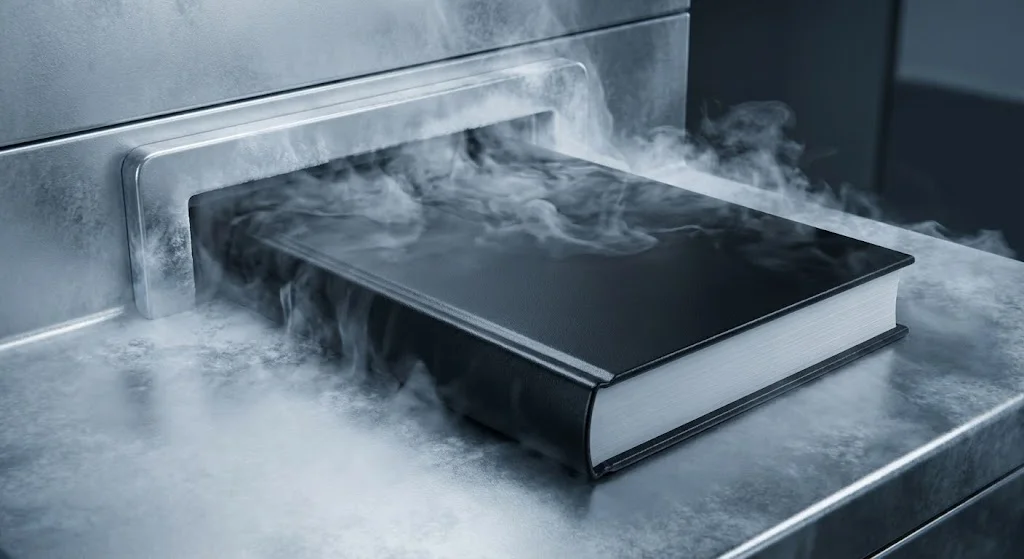
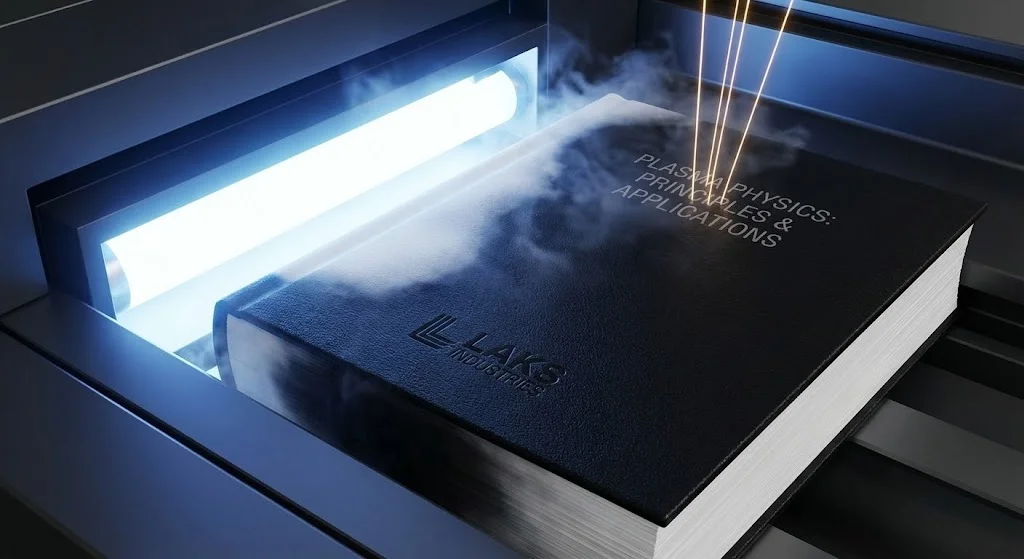
After ablation, the polymer-V blank is folded along pre-scored seams (cut by a separate longer-pulse channel during the ablation step) and pressed at the spine by an inductive heat-and-cool cycle that fuses the spine polymer without affecting the page interiors. The bound book exits the chamber inside the cassette and is ejected by the operator-facing port.
04 — The Physics Stack
SCISSION STACK
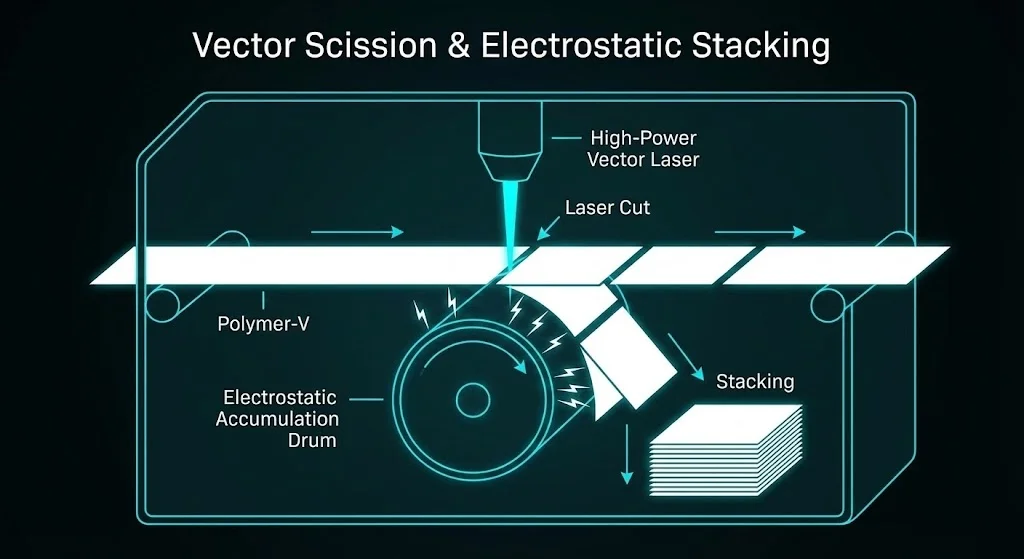
The femtosecond pulse delivers energy to the substrate faster than the substrate can dissipate it as heat. The deposition timescale (around two hundred femtoseconds) is shorter than the electron-phonon coupling timescale in polymer-V (several picoseconds), so the absorbed energy converts to a coherent plasma plume before significant thermal diffusion has occurred. The thermal damage zone around the ablated region is set by the residual plume energy that re-equilibrates with the substrate; in polymer-V, this zone is consistently below five micrometres.7
The chromophore engineering of Polymer-V is critical. A standard polymer carbonate or PET would absorb the pulse over a depth comparable to the wavelength (a few hundred nanometres), producing ablation features in that range. Polymer-V is doped with a narrow-band absorber at 248 nm that brings the absorption length down to twenty nanometres at the design pulse energy — deeper energy concentration, sharper ablation features, less spreading of the plasma plume. The polymer chemistry is the analogue of a photoresist designed for direct subtractive use rather than as a patterning mask.
Parallel ablation requires the optical system to maintain pulse phase coherence across all thirty-two channels within ±200 fs of each other. The pulse splitter is a diffractive optical element fabricated in-house using the same femtosecond technology that the chamber writes books with. The pulse-channel uniformity is monitored shot-by-shot by a photodiode array; channels that drift out of spec are corrected in the next cycle by adjusting the splitter's local phase plate.8
The vacuum environment is essential. Air at atmospheric pressure absorbs the 248 nm pulse with an absorption length of a few centimetres; even at the short chamber-to-substrate distances inside the press, the atmospheric path would impose significant pulse-energy loss and unpredictable shot-to-shot variation. The vacuum eliminates that loss; the same vacuum keeps the ablated plasma from interacting with ambient gas before reaching the cold trap.
05 — Supplier Integration
COVER HARDENING
Plasma Press depends on technology supplied by peer companies. The supplier stack is the engineering of the upstream components that make the One-Second Book possible.
Polymer Press — Supplier of the Polymer-V substrate. Chromophore chemistry, web extrusion, dimensional tolerances, and the cassette format are jointly developed. The substrate is the consumable; Polymer Press is the upstream input.
Vapor Vacuum — Vacuum-chamber engineering and the turbomolecular roughing pump line. The chamber must reach working pressure within thirty seconds of cassette load, which sets the throughput of the entire workflow. Vapor Vacuum's high-conductance pump path is the gating component.
Metallic Sciences — The stainless-steel chamber body, the cold-trap surface, the magnetic-bearing stage rails, and the inductive binding heater. The corrosion-resistant alloy stack is engineered for tens of thousands of hours of vacuum-thermal cycling.
Aetheric Sciences — The thirty-two-channel shot-controller is an Aetheric edge-compute platform with sub-microsecond per-channel timing precision. The closed-loop galvanometer control runs on the same hardware.
Highfield Magnetics — The magnetic bearings for the substrate stage and the galvanometer scanners. The bearings provide nanometre-class positioning stability under vacuum without lubricant contamination.
Fermat Logistics — Distribution of the finished One-Second Books. The Sigma-1 standard-cargo class handles the bound output; Sigma-2 handles the Polymer-V substrate cassettes inbound.
Aetheric Sciences — The content management system that converts manuscript files into the per-page ablation patterns. The conversion is template-driven: any standard publishing input format is supported.
Polymer Press → Vapor Vacuum → Metallic Sciences → Aetheric Sciences → Highfield Magnetics → Fermat Logistics →
06 — Validation Hooks
CRYO DRUM
The forward research program names three measurable claims that, if reached, would expand the platform substantially. Each is a candidate for Crystal Ball-grade prediction registration once the prediction infrastructure exists.
HOOK A — multi-layer substrate writing. The current One-Second Book uses a single Polymer-V layer per page. A multi-layer substrate (three to five chromophore-tuned strata, each addressable at a different pulse wavelength) would enable per-page colour images, embedded interactive elements (capacitive touch tracks ablated into a conductive sub-layer), and active illumination via doped organic LED layers. A demonstration of a three-layer Polymer-V substrate ablated cleanly with no cross-layer thermal damage at three discrete pulse wavelengths is the gating measurement.9
HOOK B — ablation throughput per channel. The current pulse train runs at one hundred megahertz with two hundred picojoules per pulse. A ten-fold increase in repetition rate (one gigahertz pulse train at twenty picojoules per pulse) would maintain the same energy throughput while permitting an order of magnitude finer feature resolution and proportionally shorter per-book ablation time. Demonstration of a gigahertz femtosecond pulse train with shot-by-shot uniformity below one percent over an hour-long run would unlock the next throughput tier.
HOOK C — substrate-as-display. The longer-term research target is a Polymer-V substrate that not only carries written text but also displays animated content via electrochromic doping. The chromophore would be electrically reconfigurable, so an ablated background pattern could change colour or contrast under page-edge electrical contact. This converts the book substrate into a low-power refreshable display. Demonstration of a single-page Polymer-V substrate with stable two-state colour change at sub-millisecond switching time is the gating measurement.10
RESEARCH REPOSITORY
Femtosecond ablation, polymer photochemistry, vacuum stage engineering, and high-rep-rate excimer laser systems.
Plasma Press is the engineering of publishing-as-direct-material-transformation. The discipline replaces the slow physics of conventional publishing (ink deposition and drying) with the fast physics of femtosecond-pulse ablation inside a vacuum chamber. The flagship product, the One-Second Book, produces a thirty-two-page bound volume from a single Polymer-V substrate in one second of in-chamber time, eliminating the entire ink supply chain from the workflow.
(wiki) Femtosecond Laser • (wiki) Laser Ablation • (wiki) Excimer Laser • (wiki) Photoresist • (wiki) Galvanometer Scanner • (wiki) Magnetic Bearing • (wiki) Vacuum Pump • (wiki) Chromophore • (wiki) Direct Laser Writing • (wiki) Subtractive Manufacturing
- Bäuerle, D. Laser Processing and Chemistry. 4th Ed. Springer, 2011. ISBN 978-3-642-17612-8.
- Reiser, A. Photoreactive Polymers: The Science and Technology of Resists. Wiley, 1989. ISBN 978-0-471-85457-6.
- Diels, J.-C. & Rudolph, W. Ultrashort Laser Pulse Phenomena. 2nd Ed. Academic Press, 2006. ISBN 978-0-12-215493-5.
- Sanderson, L. The Future of the Book. Berkeley: University of California Press, 1996. ISBN 978-0-520-20451-5.
- Kirner, S.V. et al. "Ultrafast laser processing of optical materials." Optical Materials Express 8, 3672–3700 (2018).
- Stuart, B.C. et al. "Optical ablation by high-power short-pulse lasers." J. Opt. Soc. Am. B 13, 459–468 (1996). The reference paper for femtosecond ablation regimes.
- Anisimov, S.I. et al. "Electron emission from metal surfaces exposed to ultrashort laser pulses." Sov. Phys. JETP 39, 375 (1974). The original two-temperature model.
- Korte, F. et al. "Far-field and near-field material processing with femtosecond lasers." Appl. Phys. A 79, 879–884 (2004). Sub-micrometre ablation feature engineering.
- Sugioka, K. & Cheng, Y. "Ultrafast lasers—reliable tools for advanced materials processing." Light: Science & Applications 3, e149 (2014).
- ● Femtosecond ablation thermal-damage zone: well-documented in the laser-machining literature. Sub-five-micrometre HAZ is achievable in many polymer systems with proper pulse-energy selection.
- ● Chromophore-tuned absorption length: standard absorption-coefficient engineering. Twenty-nanometre absorption length requires roughly a ten-percent chromophore loading by mass.
- ● Offset printing throughput: standard industry data. Modern web presses run several thousand pages per minute at the rotational and ink-curing limit.
- ● Digital production printing: roughly two hundred to three hundred pages per minute for high-end production digital. Consumable cost dominates total cost of ownership.
- ● One-Second Book platform: program target, not yet at production deployment. The constituent technologies (femtosecond lasers, magnetic-bearing stages, vacuum chambers) are individually mature; the integration is the engineering work.
- ● Thirty-two parallel galvanometer channels: at-scale parallel laser writing is demonstrated in laser semiconductor lithography. Adaptation to polymer ablation publishing is the engineering hop.
- ● Two-temperature model of femtosecond ablation: standard physics. Electron-phonon coupling time in polymers is several picoseconds, leaving a clean window for sub-picosecond pulses to deposit energy before thermal equilibration.
- ● Diffractive pulse splitter: demonstrated in research devices for multi-channel parallel laser writing. Productization at thirty-two channels is the engineering scope.
- ● Multi-layer chromophore-tuned Polymer-V: theoretical extrapolation from single-layer polymer photochemistry. Cross-layer thermal isolation is the open engineering challenge.
- ● Substrate-as-display: long-term research target. Electrochromic polymer technology exists but switching speeds and contrast ratios are below the publishing requirement.