Femtosecond Surface Conversion
THE CORE PHYSICS
Ultrafast laser pulses lasting 10−15 seconds deposit energy into the electron cloud of an engineered polymer substrate faster than thermal diffusion can carry it to the bulk material.
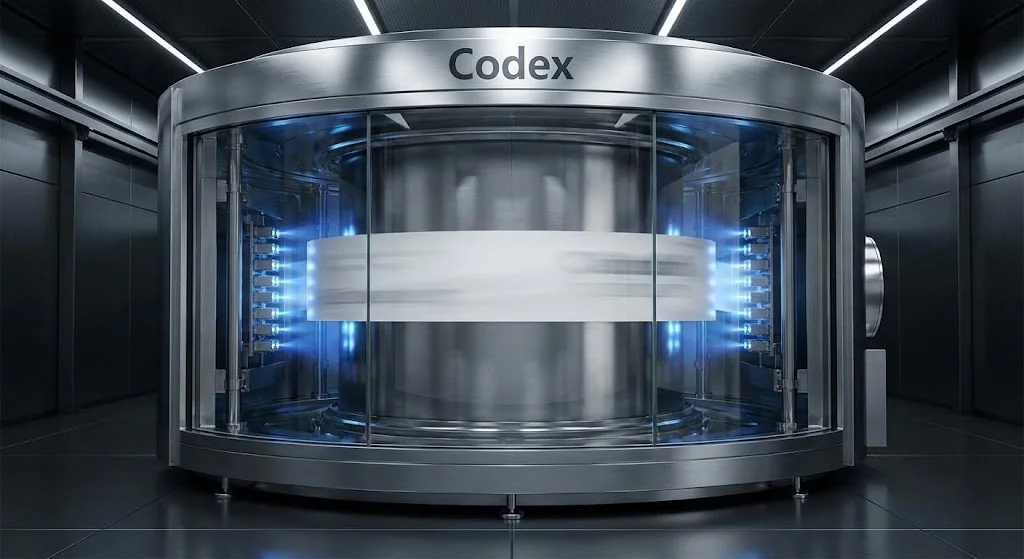
FEMTOSECOND ABLATION — COLD MATERIAL REMOVAL AT THE QUANTUM LIMIT
The Physics
A femtosecond is 10−15 seconds. Light travels 0.3 microns in one femtosecond. At this timescale, the laser pulse interacts with the electron cloud of the target material before the lattice can respond thermally. Energy is deposited into the electronic subsystem, which reaches temperatures of tens of thousands of kelvins while the surrounding lattice remains cold. The electrons transfer energy to the lattice over picoseconds — but by then, the pulse is over and the irradiated volume has already been ablated.
The result is cold ablation: material removal with zero heat-affected zone. No melting. No recast layer. No thermal stress. The boundary between processed and unprocessed material is atomically sharp. This is not an incremental improvement over nanosecond laser machining — it is a fundamentally different physical regime.[1]
Application to Printing
When the target is Polymer-V — an anhydrous, high-tensile thermoplastic engineered by Polymer Press — the femtosecond pulse converts a thin surface layer into a carbon-rich, high-contrast mark. The conversion is permanent and immediate. No ink. No drying cycle. No curing. The imaging event occurs at the speed of light.
Standard paper contains water that boils in vacuum, destroying the sheet. Polymer-V is chemically stable in hard vacuum, carries a 500-year projected archival rating, and undergoes a clean photothermal transition under ultrafast irradiation. A single spool feeds the entire process — pages and covers come from the same material.[3]
Color via Substrate-X Chroma
Full color is achieved through the Substrate-X Chroma system: four species of leuco-dye nanocrystals embedded in the polymer, each activated by a specific laser wavelength — 405 nm (cyan), 520 nm (magenta), 638 nm (yellow), 1064 nm (black). The Quad-Wave Laser Array fires all four channels simultaneously. Color is permanent — structurally locked nanocrystals that do not fade, bleed, or smudge.[4]